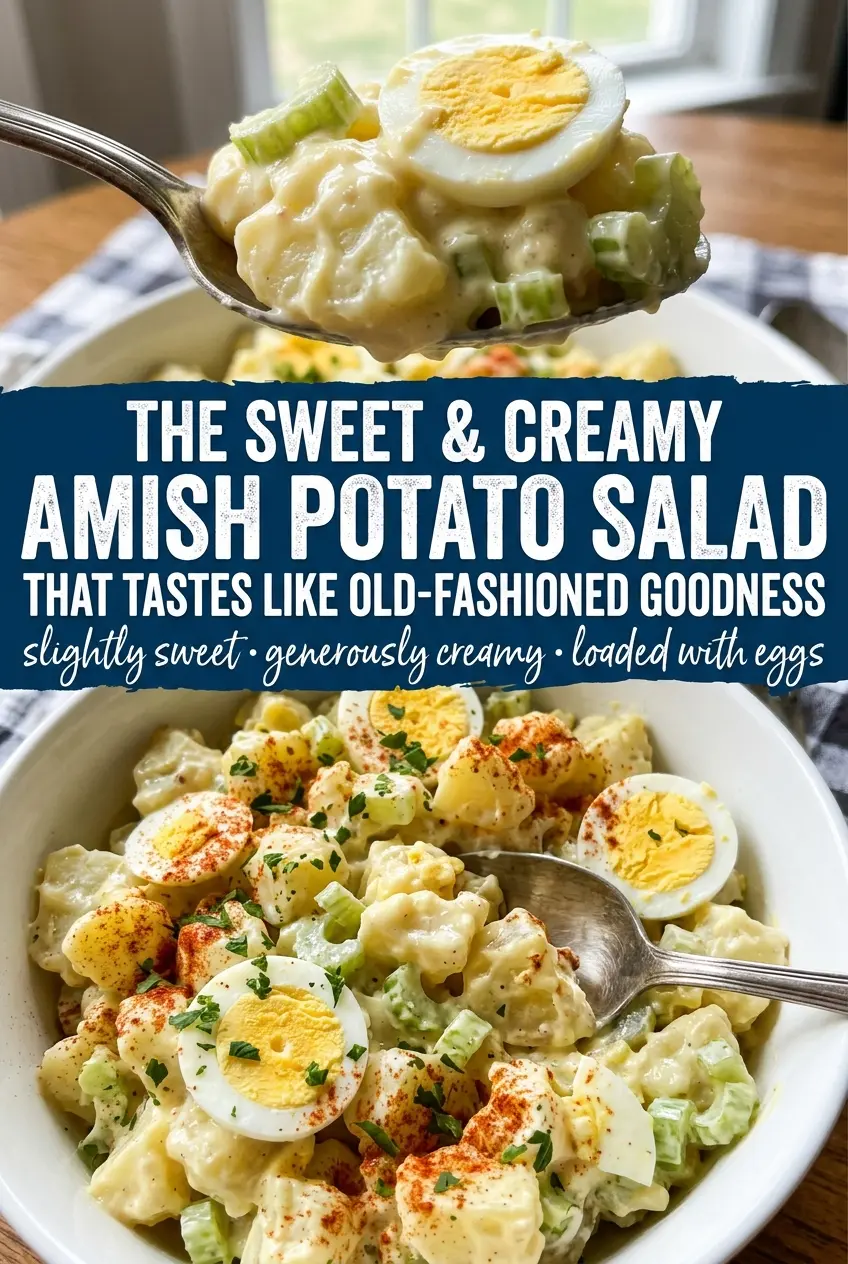
Amish potato salad lands with that exact balance people come back for: soft potatoes that hold their shape, chopped eggs for richness, and a dressing that tastes creamy first and tangy right behind it. It’s the kind of side dish that disappears fast at a cookout, but it’s just as at home next to fried chicken, ham, or anything coming off the grill.
The trick is in the contrast. The potatoes need to be cooked until tender but not collapsing, then cooled enough that they don’t melt the dressing on contact. The dressing itself is built with mayonnaise, sugar, yellow mustard, and vinegar, which gives you that classic sweet-tart finish without tasting heavy or flat. The eggs matter here too; they add body and make the salad feel substantial instead of just creamy.
Below, I’ve included the small details that keep the salad from turning gluey, plus a few ways to adjust it if you want it a little sharper, a little sweeter, or better suited to making ahead for a crowd.
The potatoes held their shape after chilling and the dressing was creamy with just enough tang. I made it the night before a picnic and it was even better the next day.
Love the creamy, tangy balance in this Amish Potato Salad? Save it to Pinterest for your next church potluck or backyard cookout.
Why the Dressing Stays Creamy Instead of Turning Thin
The biggest mistake with potato salad is dressing warm potatoes with a thin, overmixed sauce. Warm potatoes keep absorbing liquid as they cool, which can leave you with a salad that looks fine at first and then turns dry and pasty after an hour. This version works because the potatoes are cooled first, then folded gently with a dressing that’s thick enough to cling without getting heavy.
Yellow mustard and vinegar do the balancing here. The mustard gives the dressing backbone, while the vinegar keeps the sugar from making the salad taste flat. If your dressing tastes sharp in the bowl, don’t panic — that edge softens once it sits with the potatoes and eggs.
- Russet or Yukon Gold potatoes — Russets make a softer, more classic potluck-style salad, while Yukon Golds hold their shape a little better. Either works, but don’t overcook them or they’ll break apart when you fold in the dressing.
- Mayonnaise — Use a full-fat mayo for the best texture. Light mayo can work in a pinch, but the dressing won’t cling as well and the salad can taste thin after chilling.
- Yellow mustard — This gives the salad its familiar Amish-style tang and color. Dijon changes the flavor enough to make the whole dish taste less traditional.
- Vinegar — White vinegar is clean and sharp here. Apple cider vinegar is the best swap if that’s what you have, but it brings a slightly fruitier finish.
- Hard-boiled eggs — Chop them fairly small so they distribute through the salad instead of turning it into egg salad with potatoes. They add richness and help the texture feel creamy without extra mayo.
What Each Ingredient Is Actually Doing in Creamy Dressing

- Mayo or sour cream (the base) — The creamy base is essential. Quality matters here; cheap mayo tastes thin and one-dimensional.
- Acid (vinegar or lemon juice, prevents thinning) — The acid stabilizes the emulsion and prevents the dressing from breaking. It also adds brightness.
- Mustard (helps emulsify and stabilize) — Mustard acts as an emulsifier that keeps the mayo from separating. It also adds flavor depth.
- Seasonings (salt, pepper, herbs) — Bold seasoning makes the dressing taste intentional. Shy seasoning makes it taste thin and flavorless.
- No excess liquid (keep it thick) — Don’t thin the dressing with milk or water. Keep it thick so it doesn’t turn watery.
- Temperature (keep cool or room temperature) — Hot dressing breaks the emulsion. Keep ingredients cool for a stable dressing.
- Optional: egg yolk (for extra richness and emulsion) — A raw egg yolk adds richness and helps stabilize the dressing. Use pasteurized eggs if concerned about safety.
- Taste and adjust (check balance) — The dressing should taste rich and well-seasoned. Add acid if it tastes heavy; add mayo if it tastes thin.
The Quiet Steps That Keep the Potatoes From Falling Apart
Boil the potatoes in salted water until a knife slides in easily but the cubes still hold their edges. If they’re even a little overcooked, the salad gets muddy once you fold in the dressing. Drain them well, then let them cool enough that they’re just warm or fully room temperature before mixing.
Cooking the Potatoes Just to Tender
Start the potatoes in cold water so they cook evenly from the outside in. Once the water comes up to a boil, lower it to a steady simmer; a hard boil will batter the cubes and split the skins before the centers are done. Test a piece from the middle of the pot, not just the top, because the small pieces will soften first.
Building the Dressing
Whisk the mayonnaise, sugar, mustard, vinegar, salt, and pepper until the sugar dissolves and the mixture looks smooth and glossy. If it still feels grainy, keep whisking for another minute; undissolved sugar can leave the dressing sandy after chilling. Taste it now, not after it’s on the potatoes, because the salad will mute the sharpness as it rests.
Folding Without Crushing
Add the potatoes, eggs, celery, and onion to a large bowl, then pour the dressing over the top and fold with a spatula instead of stirring aggressively. The goal is to coat every piece while keeping some texture intact. If you mash as you mix, the salad turns heavy and loses that classic, spoonable finish.
The Chill That Makes It Taste Right
Cover the bowl and refrigerate for at least 3 hours, or overnight if you can. That resting time lets the potatoes absorb the dressing and gives the sugar, vinegar, and mustard a chance to settle into the background instead of tasting separate. Right before serving, sprinkle paprika over the top for color and that familiar potluck look.
How to Adjust Amish Potato Salad for Your Table
A Sharper, Less Sweet Version
Cut the sugar back to 1/4 cup and add an extra tablespoon of vinegar. You’ll lose some of the classic sweet-potato-salad character, but the result is brighter and a little more balanced if you don’t want the dressing leaning dessert-sweet.
Dairy-Free by Default
This recipe already skips dairy, so it’s an easy fit as written. Just check your mayonnaise label if you’re cooking for someone with a strict allergy, since some brands use different processing or add-ons.
Adding More Crunch
Keep the celery as written, then add a handful of finely diced dill pickles or sweet pickles if you want more bite. Add them sparingly, though, or the extra moisture will thin the dressing and pull attention away from the potatoes.
Storage and Reheating
- Refrigerator: Keep covered for up to 4 days. The salad actually improves after a few hours, but it will tighten up as it chills, so let it sit at room temperature for 15 to 20 minutes before serving if needed.
- Freezer: I don’t recommend freezing it. The mayonnaise breaks and the potatoes turn grainy once thawed.
- Reheating: Serve this chilled or cool, not hot. If it sits out too long at a picnic, give it a quick stir and a spoonful of mayo only if it looks dry; don’t heat it, because warmth changes the texture and makes the dressing greasy.
Answers to the Questions Worth Asking
Amish Potato Salad
Ingredients
Equipment
Method
- Boil the potatoes in a Dutch oven of water until tender, about 20 minutes, until a knife slides in easily (visual cue: cubes soften uniformly). Drain and spread them on a sheet pan to cool completely, about 10 minutes, so the salad stays creamy instead of watery.
- Combine cooled potatoes with chopped hard-boiled eggs, diced celery, and finely diced onion in a large bowl (visual cue: eggs are evenly distributed throughout the potatoes).
- Mix mayonnaise, sugar, yellow mustard, white vinegar, salt, and pepper until smooth, stirring until the mixture looks glossy and fully combined (visual cue: no sugar or mustard streaks remain).
- Pour the dressing over the potato mixture and fold gently until every piece is coated (visual cue: the salad turns a uniform pale creamy color).
- Refrigerate for at least 3 hours or overnight, 180–480 minutes, so the flavors meld and the salad thickens (visual cue: it holds shape when scooped).
- Garnish with paprika right before serving for a classic speckled look (visual cue: pinkish-red dusting over the top).